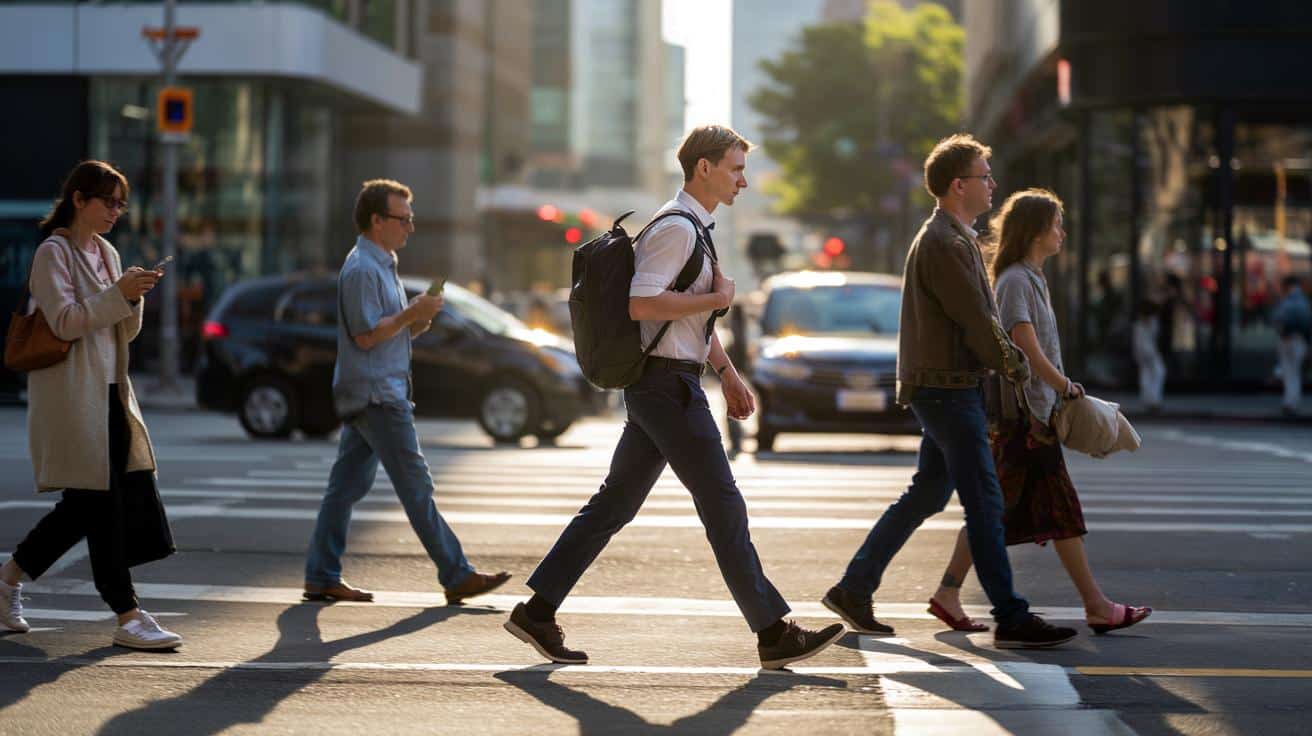
You notice it most at crosswalks.
The light turns green and a small crowd starts forward, but there’s always that one person who seems to slice the air ahead of everyone else. Head slightly tilted down, bag pulled close, steps quick and purposeful, as if there’s an invisible deadline only they can see.
Next to them, someone else scrolls their phone, strolling like they’re walking through a Sunday painting. The gap between them grows in seconds, and you can almost feel the difference in their inner worlds.
Behavioral scientists have been watching that gap very closely.
And what they’re finding about fast walkers is… oddly consistent.
What behavioral scientists see when they watch people’s walking speed
If you stand on a busy sidewalk long enough, you start to notice patterns.
The people weaving around others, taking slightly wider steps, barely slowing down for anyone – they tend to look focused, almost “on a mission”.
Researchers see the same thing in the data. Across multiple studies, people who naturally walk faster than average consistently show higher levels of **conscientiousness and ambition**. They’re the ones who arrive early, plan ahead, and hate wasting time.
Their bodies move like their minds: forward, brisk, rarely idle.
It’s not just a style. It’s a personality fingerprint in motion.
One large study from the University of Leicester analyzed the walking speeds and self-reported personalities of more than 400,000 adults in the UK.
People who walked faster weren’t just fitter or younger. Over and over, they also scored higher on traits like drive, self-discipline, and goal orientation.
Another experiment had volunteers walk at their natural speed, without being told they were being evaluated. Then researchers compared that speed to personality tests. Those at the front of the curve were more likely to describe themselves as competitive, impatient with delays, and energized by challenges.
On the flip side, the slowest walkers didn’t just move gently. Many scored higher on calmness and introversion. Some also reported feeling more tired, stressed, or emotionally overloaded.
Why would walking speed say so much about who you are?
Scientists point to a mix of biology, mindset, and environment.
➡️ French foreign trade booms in this Chinese region with +32.7% exports year‑on‑year to €432 million
➡️ Psychology says preferring solitude over constant social life is a subtle sign of these 8 traits
➡️ A mine with a potential value of €120 billion found in the United States
➡️ Why a splash of vinegar in the cooking water keeps sausages from bursting
A naturally brisk walker often lives with a strong internal clock. They feel time passing more sharply, and they hate the sense of falling behind. Their body reflects that urgency, even on a casual walk to the store.
They also tend to have a clearer mental map of their day. Instead of floating from task to task, they see the next three steps ahead. Walking slowly would clash with that internal rhythm. *Their feet hurry to keep up with their brain.*
On the other side, slow walkers frequently prioritize presence over progress. They’re not always “less motivated” – sometimes they’ve simply chosen to resist the pressure to rush.
How to read (and gently use) your own walking speed
One practical exercise suggested by behavioral researchers is almost laughably simple.
Next time you walk a familiar route – to the bus stop, the corner shop, the coffee place you always go to – time yourself.
Walk at your natural, comfortable pace. Don’t push. Don’t perform. Just walk the way you would if no one cared.
Then another day, repeat the same route, but consciously walk 20–30% faster. Notice how your thoughts change. Do you feel sharper, more stressed, more focused, more annoyed?
That tiny shift is like a live demo of your own mental wiring.
You’re not just changing speed. You’re changing the story your body tells your mind.
Here’s where many people trip themselves up.
They think, “Fast is good, slow is bad,” and try to turn every walk into a productivity contest. That’s not what scientists are saying at all.
Walking quickly can signal drive, but it can also hide anxiety, people-pleasing, or chronic overwork. Walking slowly can mean calm confidence, or it can hint at low energy and mood. Context matters.
We’ve all been there, that moment when your legs feel heavy, you drag your feet, and your thoughts feel just as slow. On those days, walking pace is more of a mirror than a diagnosis.
Let’s be honest: nobody really tracks their “average walking speed” every single day.
But noticing your pace once in a while can gently flag what your brain is doing behind the scenes.
Behavior specialist Dr. Andrew Lane summed it up in a way that sticks:
“People don’t just walk at a certain speed. They walk at the speed of their priorities and their inner weather.”
That “inner weather” shows up in other patterns too. Many fast walkers also:
- Interrupt more in conversations when they feel time pressure
- Feel guilty when they sit still without “producing” anything
- Prefer firm plans over spontaneous last-minute changes
- Get irritated by people who dawdle in doorways or escalators
None of this makes them “better” or “worse”.
It just means that what looks like a simple stride down the street is actually a quiet, daily reveal of what runs the show inside.
What your pace might be telling you about your life right now
Once you start noticing, walking speed becomes a kind of moving check-in.
You’re late for nothing, the sun is out, your bag isn’t heavy – and yet you’re marching like a CEO in a crisis. That’s worth a raised eyebrow from yourself.
Fast walkers often discover that their default speed is tied to a story they absorbed years ago: “If I’m not rushing, I’m slacking.” Even alone, they unconsciously perform productivity. The street turns into a silent to‑do list.
Slower walkers sometimes realize they’re savoring the world on purpose. They notice faces, shop windows, trees. Or they realize that the heaviness in their steps has quietly grown with their stress, their sleep debt, or their low mood.
Both are clues. Both are invitations to ask: “Who’s setting the pace here – me, or my autopilot?”
| Key point | Detail | Value for the reader |
|---|---|---|
| Walking speed reflects traits | Fast walkers often score higher in conscientiousness, ambition and time awareness. | Helps you understand what your pace might reveal about your personality. |
| Context changes the meaning | Health, mood, stress and environment all influence how fast you walk on a given day. | Avoids rushing to judge yourself or others purely based on speed. |
| You can use pace as feedback | Noticing when you speed up or slow down can signal overload, pressure, or presence. | Gives you a simple everyday tool to check in with your mental state. |
FAQ:
- Question 1Does walking fast automatically mean I’m more successful?
- Answer 1No. Fast walkers often score higher in drive and urgency, but success depends on many other factors: opportunity, health, relationships, luck, and how you manage that drive over time.
- Question 2Can I “train” myself to become a fast walker and change my personality?
- Answer 2You can change your walking pace with practice, and that can shift how you feel in the moment, but personality change is slower and deeper. Walking speed is more of a signal than a magic switch.
- Question 3What if I walk slowly because of health issues?
- Answer 3Then your pace reflects your body more than your personality. Behavioral studies typically adjust for age and health, and no serious scientist would judge character based on a medical limitation.
- Question 4Is there an “ideal” walking speed?
- Answer 4There’s an average adult pace (around 1.2 to 1.4 meters per second), but no moral ideal. The best pace is one that respects your body, your environment, and what you actually need from that walk.
- Question 5Can noticing my walking speed really change anything in my life?
- Answer 5It won’t rewrite your story overnight, but it can quietly highlight when you’re running on pressure or drifting into exhaustion. From there, you can choose to slow down, speed up, or simply walk with more awareness.