The first thing you notice is the quiet.
Not total silence, just a soft dimming of the world, like someone pulling the fader down on reality. Birds stop mid-song. Street dogs hesitate. People lift their phones, then forget to hit record because the sky suddenly feels more interesting than any screen.
Then the light goes strange – metallic, almost underwater – and a ripple of unease runs through the crowd. Someone laughs too loudly. Someone else swears softly, not out of anger but surprise.
And then, in the middle of a perfectly ordinary day, the Sun simply… goes out.
For six long minutes, the world is reminded who’s in charge.
Eclipse of the century: when the six minutes of darkness will fall
Astronomers are already calling it *the eclipse of the century*.
On June 13, 2132, a total solar eclipse will cut across Earth and plunge parts of the daytime world into night for a staggering six minutes and 55 seconds at maximum. That’s almost double the time of many recent eclipses, long enough to feel your body adapt to a temporary new reality.
This ultra-long event hasn’t come out of nowhere. It’s the result of rare orbital geometry: the Moon will be unusually close to Earth, and the path will cross near the equator, where our planet’s rotation stretches the shadow’s footprint.
For sky-watchers, it’s the kind of date you circle in red and quietly build your life around.
To get a taste of what’s coming, you only have to look back at the longest eclipse of the 21st century: July 22, 2009.
That one lasted up to 6 minutes 39 seconds over the Pacific, and people who were there still talk about it like a life benchmark: “before the eclipse” and “after the eclipse.” Small fishing towns in China shut down for the day. In India, families camped on rooftops. Planes were chartered just to chase the Moon’s shadow.
The upcoming 2132 event goes a little further. It’s predicted to be one of the very rare eclipses in recorded history to flirt with the seven-minute mark. Statistically, that puts it in a tiny elite club of total eclipses human eyes have ever seen.
For future generations, these six-plus minutes will likely become a shared story, passed down like a cosmic campfire tale.
➡️ How preparing once prevents repeated stress
➡️ Why a splash of vinegar in the cooking water keeps sausages from bursting
➡️ A mine with a potential value of €120 billion found in the United States
➡️ Psychology says preferring solitude over constant social life is a subtle sign of these 8 traits
➡️ “One in 200 million”: fisherman hauls in electric-blue lobster with extraordinary colour
➡️ French foreign trade booms in this Chinese region with +32.7% exports year‑on‑year to €432 million
Why does this one last so long?
Eclipse duration is a dance of three main factors: the Earth’s rotation, the Moon’s distance, and the position of the eclipse path. When the Moon is closer to Earth, it looks slightly larger in the sky, casting a wider shadow. When that shadow sweeps across the equator, where Earth spins fastest, the ground “moves into” the shadow for longer.
On June 13, 2132, those variables line up almost perfectly. The Moon will be near perigee (its closest point to Earth), the eclipse path will hug low latitudes, and the Sun will be high in the sky for much of the track. That combination stretches totality into a near-record performance.
Astronomers calculate these things decades, even centuries in advance. The math is dry. The experience won’t be.
The best places on Earth to watch the six-minute eclipse
If you want the longest darkness, you need to stand directly under the Moon’s central shadow, on what scientists call the “path of totality.”
For the 2132 eclipse, early projections place that path running across parts of the eastern Pacific Ocean, brushing potential land areas in Southeast Asia and possibly sections of the western Americas. The absolute maximum duration is expected to occur over open water, as so often happens with record-breaking eclipses.
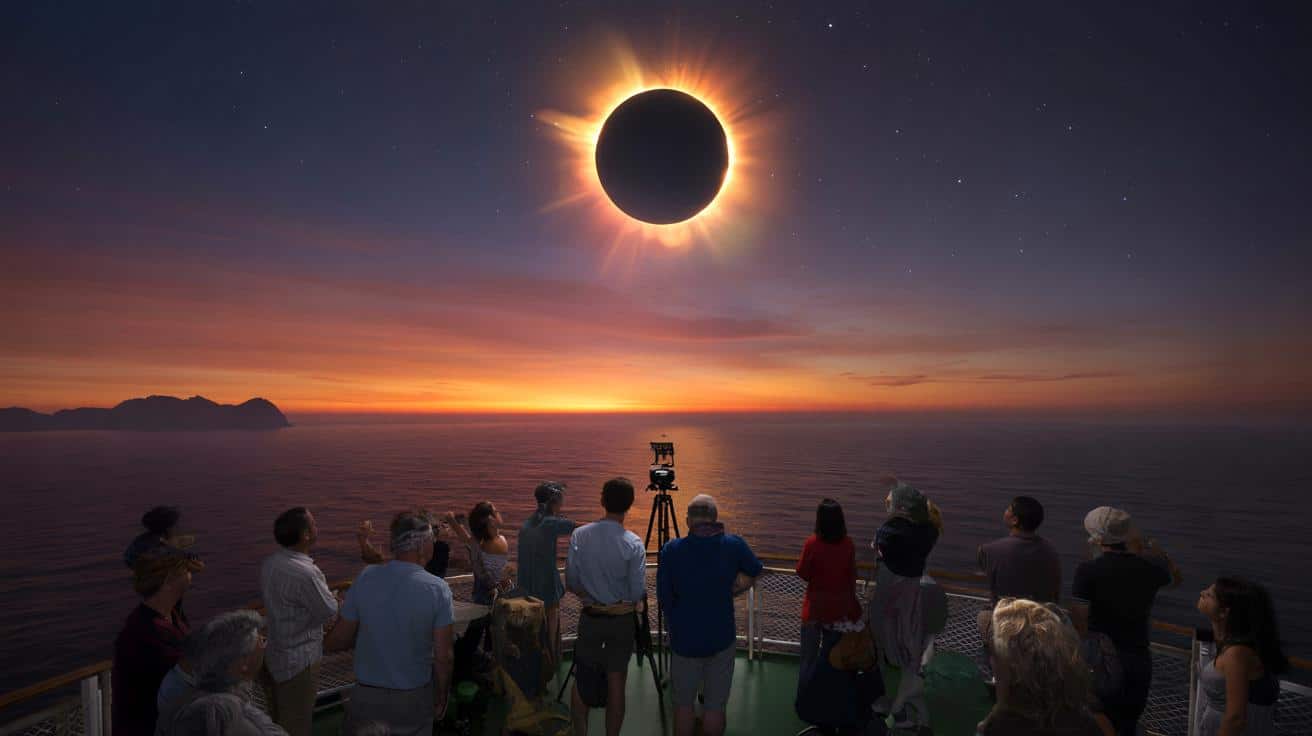
That doesn’t mean you’re stuck at sea. Cruise companies and specialist tour operators are almost certain to offer “eclipse expeditions,” positioning ships directly in the shadow’s core. On land, coastal regions near the path will still get several minutes of totality, just a little shorter than the ocean peak.
The key is simple: the closer you are to the centerline, the longer your night-in-day.
We’ve all been there, that moment when a big celestial event hits the news and you realize you’re on the wrong continent.
People have uprooted their lives to avoid that feeling. For the 2017 total eclipse in the United States, one Oregon town of 9,000 took in over 100,000 visitors in a single day. Locals rented out lawns to campers, cafes ran out of coffee by midday, and traffic jams stretched for dozens of kilometers.
Expect the 2132 event to trigger the same kind of gravitational pull on travelers, only louder. Families may plan multi-generation trips, pairing the eclipse with long-postponed holidays in Asia or the Pacific. Amateur astronomers will haul telescopes across borders. Students will backpack toward the shadow line just to be able to say: “I saw the long one.”
Cities near the path will quietly start preparing years earlier than anyone admits publicly.
Under the poetry, there’s a sober reality: you don’t just “show up” to a once-in-a-century eclipse.
Airports along the path will likely face surging demand. Hotels will price accordingly. Cloud statistics suddenly matter as much as flight times. Locations with historically clear June skies and decent infrastructure will become prime targets, even if they don’t get the full six minutes.
Analysts already know the pattern from previous major eclipses. Regions that offer:
good weather odds, political stability, easy transport, and coastal or high-altitude views
tend to win the crowd. Remote islands and research vessels will chase maximum duration. Big cities just off the centerline will market themselves as “eclipse hubs,” banking on people who want the experience plus restaurants, culture, and a soft bed.
Let’s be honest: nobody really reads climate charts for a trip a decade away. Yet for this event, more and more people will.
How to actually experience those six minutes (without ruining them)
You don’t need fancy equipment to feel your stomach drop when the Sun disappears.
What you do need is a simple plan. The rhythm of an eclipse is oddly fast: partial phase builds for over an hour, then totality slides past in what feels like seconds. The best approach is low-tech. Before the big day, rehearse your moves: where you’ll stand, where your eclipse glasses are, where your camera is pointed. Then, when the shadow comes, drop most of it.
Many seasoned chasers recommend one camera on a fixed tripod, set and forgotten, and your own eyes free. During totality, it’s safe to look with the naked eye. That’s when you’ll see the corona, the stars, the planet-like glow on the horizon.
The goal isn’t to get perfect photos. It’s to actually be there.
The biggest mistake people report is spending the whole eclipse staring at a screen.
You fiddle with focus. You check exposure. You switch from video to photo and back again, then suddenly someone yells, “Diamond ring!” and it’s over. If you’re traveling with friends or kids, talk about this ahead of time. Decide who’s filming, who’s just watching, and what you’re okay not capturing.
The second classic error is underestimating logistics. Traffic, crowded viewpoints, missing eclipse glasses – they sound like small problems until you’re stuck behind a line of cars while the Moon’s shadow races without you. Arrive early, pick a backup spot, and bring extra glasses to share. That one small gesture can flip someone else’s day from frustration to awe.
An eclipse doesn’t wait for latecomers, no matter how far they’ve flown.
“During my first total eclipse, I cried without understanding why,” admits French astrophotographer Lucie Martin. “The world went dark, the temperature dropped, and for a few minutes I felt tiny and completely connected at the same time.”
- Pack smart, not heavyThink layers for temperature drops, a hat for pre-totality Sun, eclipse glasses, a simple camera or phone, water, and snacks. Comfort buys you attention.
- Time-box your photosDecide in advance: two minutes for shooting, four minutes for watching. Or one sequence at the start, then camera down. Protect at least half of totality for your bare senses.
- Watch the world, not just the skyThe shadow racing across hills, birds going silent, people gasping around you – those side scenes are often what you remember most years later.
A shared shadow that stretches across generations
There’s a quiet irony baked into this “eclipse of the century.”
Most of the people reading forecasts about June 13, 2132 today won’t be there in person. That stings a little, and yet it doesn’t empty the event of meaning. The knowledge itself connects us forward. Kids alive now could be the elders telling stories under that strange midday night.
Eclipses bend time like that. A photograph from a 1927 totality in England looks eerily similar to one from 2017 in the United States: the same black disc, the same ghostly corona, different clothes and accents along the viewing line. These six minutes will join that archive – another frame in a very slow cosmic film.
Maybe the real invitation is this: talk about it. With your children, your students, your friends online. Plant the idea that, someday, someone you love might stand in that shadow, look up, and feel, just for a moment, where we sit in the universe.
The Sun sets every day. It almost never disappears at noon.
| Key point | Detail | Value for the reader |
|---|---|---|
| Once-in-a-century duration | Total eclipse on June 13, 2132, with up to ~6 min 55 s of darkness | Understands why this event is extraordinarily rare and newsworthy |
| Best viewing zones | Path of totality across the Pacific and parts of Asia/Americas, with maximum over ocean | Helps future travelers and dreamers target regions worth tracking |
| Experience over perfection | Simple prep, limited photography, and attention to atmosphere and feelings | Guides readers toward a richer, more human encounter with the eclipse |
FAQ:
- How long will the “eclipse of the century” actually last?
From first bite of the Moon to the last, the whole event will take around two to three hours at any given spot, but totality itself near the maximum point is forecast to last close to seven minutes.- Where will you get the longest view of totality?
The absolute longest darkness is expected over the Pacific Ocean along the centerline, which is why specialized eclipse cruises and research ships will likely target that zone.- Will any big cities be directly in the path?
Detailed maps will tighten over time, but early projections suggest that major population centers may sit just off the center, getting slightly shorter totality rather than the full record-breaking stretch.- Is it safe to look at the eclipse with the naked eye?
Only during the brief phase of totality, when the Sun is completely covered. Before and after that, you need certified eclipse glasses or proper filters, even if the Sun looks almost gone.- Why do some eclipses last much longer than others?
Duration depends on the Moon’s distance from Earth, the angle and speed of its shadow across our planet, and where the path falls relative to the equator. When those line up just right, you get a marathon eclipse instead of a sprint.