Chinese engineers have quietly finished assembling one of the most powerful scientific centrifuges ever built, a device designed not for astronauts or fighter pilots, but to fast‑forward the behaviour of our planet itself.
A centrifuge built to bend time and space for science
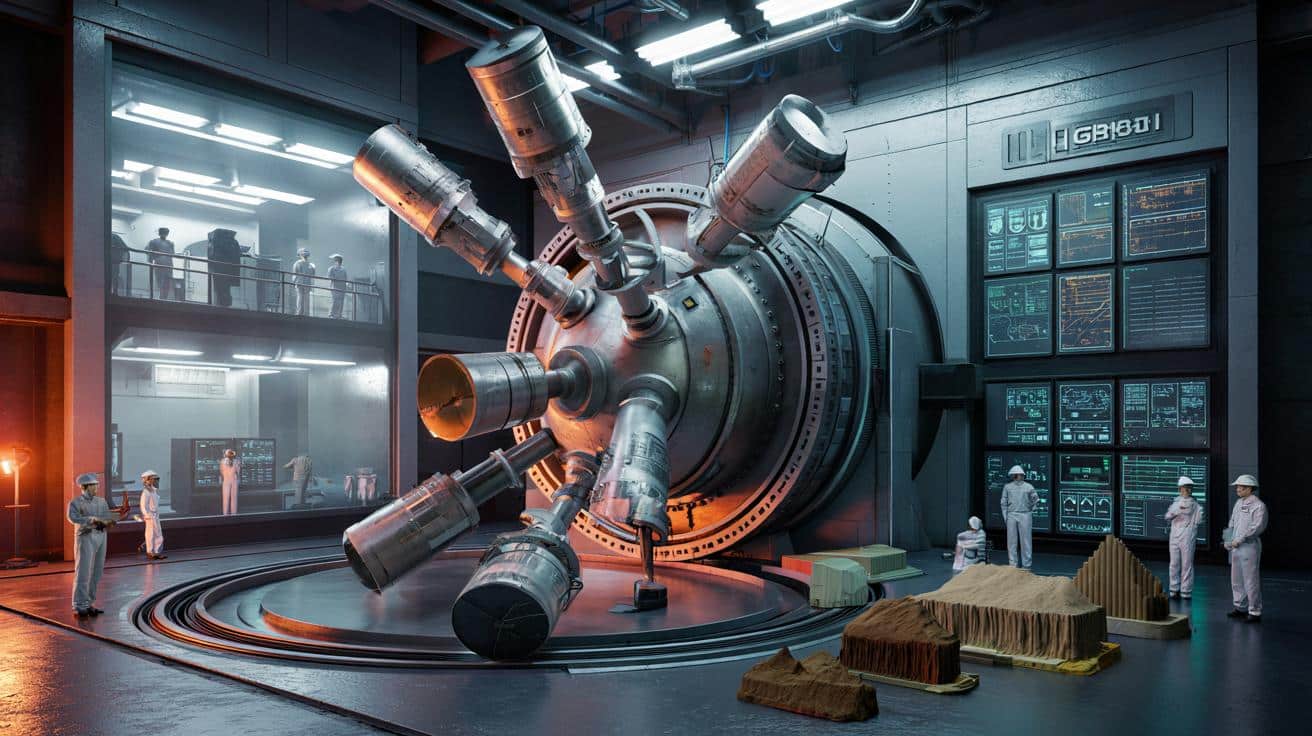
The machine is called CHIEF1900, and it has been developed by Shanghai Electric Nuclear Power in just five years. It is not a sleek space-age capsule. It is a hulking industrial rig weighing many tonnes, bolted into a purpose-built facility near Zhejiang University in Hangzhou.
Its job is simple to describe and hard to achieve: use extreme rotation to generate “hypergravity” far beyond what we experience at Earth’s surface. Under these conditions, researchers can watch slow natural processes unfold at high speed and on a smaller scale.
By pushing materials to up to 1,900 g‑tonnes, CHIEF1900 lets engineers watch centuries of stress, erosion or seepage in a matter of hours.
The number in its name is not branding flair. It refers to its hypergravity capacity: 1,900 g‑tonnes, a way of expressing how much mass can be subjected to how many multiples of Earth’s gravity. On that metric, it is now the most powerful centrifuge of its kind in the world.
How hypergravity “compresses” time and distance
Everything on Earth already feels two key forces: gravity pulling us towards the ground and a modest centrifugal effect from the planet’s rotation. In daily life, those are almost invisible. CHIEF1900 exaggerates the centrifugal side to an absurd degree.
By spinning at ultra‑high speed, the arms of the centrifuge fling test samples outward with thousands of times normal gravity. The physics stays the same, but the scale changes dramatically.
Under these conditions:
- Soil can compact or slide as if under a mountain’s weight.
- Concrete and steel can deform as though supporting a mega‑dam.
- Pollutants can seep through rock layers as if centuries had passed.
Engineers talk about “compressing time and space” because large, slow processes can be recreated in small, fast experiments.
Hypergravity makes a one‑metre soil column behave like a kilometres‑deep formation, and days in the lab stand in for thousands of years in the ground.
➡️ A mine with a potential value of €120 billion found in the United States
➡️ “One in 200 million”: fisherman hauls in electric-blue lobster with extraordinary colour
➡️ French foreign trade booms in this Chinese region with +32.7% exports year‑on‑year to €432 million
➡️ How preparing once prevents repeated stress
➡️ Why a splash of vinegar in the cooking water keeps sausages from bursting
Breaking the US record and leaving rivals behind
Until now, the benchmark for this kind of facility was a centrifuge operated by the US Army Corps of Engineers in Vicksburg, Mississippi. That machine reaches around 1,200 g‑tonnes.
CHIEF1900 leaps far beyond that, adding more than 50% extra capacity. It replaces China’s own CHIEF1300, which only entered service in September last year and itself briefly held the record. The pace of upgrade hints at a strategic push: China wants the best hypergravity lab on the planet, and it is willing to iterate fast.
For China’s wider technology ambitions—from nuclear power and mega‑infrastructure to seabed mining and deep geological storage—such a tool offers a clear advantage: risky designs can be tested under exaggerated stress before anyone breaks ground.
Six test chambers, one machine: what CHIEF1900 will study
Inside the centrifuge, six test chambers can be loaded with carefully prepared scale models or material samples. Each chamber can host a different type of experiment, making CHIEF1900 more like a cluster of labs at the end of a rapidly spinning arm.
From landslides to mega‑dams
Chinese teams have laid out a crowded research agenda. Expected applications include:
- Slope and dam engineering – testing how embankments and large dams respond to long‑term pressure, heavy rainfall or sudden load changes.
- Seismic geotechnics – simulating earthquakes in hypergravity to see how soils and foundations behave when the ground shakes.
- Deep‑sea engineering – modelling how structures cope with intense pressure and shifting sediments on the ocean floor.
- Deep Earth environments – studying how rock layers deform and fracture under extreme loads, relevant to tunnels, mines and underground storage.
- Geological processes – speeding up sedimentation, erosion and fault formation to test theories normally checked only by field observation.
- Materials treatment – exposing alloys, composites and even biological cells to hypergravity to see how their microstructure changes.
Hypergravity testing gives engineers a rehearsal: bridges, tunnels and reservoirs can fail safely in miniature before they confront real‑world stress.
Tracking pollution over “millennia” in the lab
One area that stands out is the movement of pollutants through soil and rock. Usually, understanding how chemicals migrate underground means either waiting a long time or relying heavily on computer models.
With CHIEF1900, researchers can pack layers of soil, clay and rock into a chamber, introduce contaminants such as heavy metals or industrial waste, and then spin the system at high g‑levels. The intensified gravity speeds up flow and diffusion, mimicking what might happen over tens of centuries.
That kind of insight matters for nuclear waste disposal, deep chemical storage, and large landfill sites. It also gives regulators more solid data when deciding where certain types of facilities should be built—or banned.
An engineering nightmare turned working machine
Just over a year ago, the structure to hold CHIEF1900 did not even exist. Building a housing capable of handling such a machine is a project in its own right.
The centrifuge must spin heavy loads at high speed without tearing itself free from its foundations. Bearings, arms and fixtures all need to survive colossal forces. Any imbalance could shake the building or damage the device.
Heat is another enemy. High‑speed rotation generates significant thermal load. To prevent overheating, the team designed a vacuum‑based temperature control system that combines liquid cooling with directed ventilation. The vacuum reduces air resistance, lowering friction and heat, while the coolant loop carries away the remaining energy.
Running CHIEF1900 safely means mastering vibration, heat and vacuum control at scales that push current industrial norms.
Why hypergravity matters beyond space travel
Hypergravity research is often associated with human spaceflight—testing how bodies cope with extreme acceleration. CHIEF1900 can certainly host biological samples, from plant cells to small animals, to see how tissues respond when effectively weighed down thousands of times.
Yet most of its planned workload is firmly terrestrial. The centrifuge serves civil engineers, environmental scientists, geologists and materials specialists at least as much as it serves space agencies.
For a fast‑urbanising country that builds high‑speed rail, massive dams and deep tunnels at speed, having a way to stress‑test designs before construction provides a strategic safety net.
Key terms behind China’s giant centrifuge
A few technical phrases are likely to recur around CHIEF1900, and they are worth clarifying:
| Term | What it means |
|---|---|
| g (gravity) | A measure of acceleration relative to Earth’s gravity. 1 g is normal weight; 10 g is ten times heavier. |
| g‑tonne | A way of combining the mass of the test load with the gravity applied. Higher g‑tonnes mean more extreme conditions. |
| Hypergravity | Any gravity level significantly above 1 g, often in the hundreds or thousands for engineering tests. |
| Geotechnical engineering | The study of soil and rock behaviour for foundations, slopes, tunnels and underground structures. |
What could go wrong, and what the gains might be
Machines this powerful raise obvious questions. A mechanical failure during high‑g runs could damage the facility or injure staff. That is why such centrifuges are heavily shielded, remotely operated and fitted with multiple emergency stop systems.
There are ethical debates too. Long‑term biological experiments in hypergravity could produce data relevant to human performance limits, which in turn feeds military and aerospace ambitions. Transparency about research goals will matter to build trust across borders.
The benefits, though, are tangible. A single successful experiment on CHIEF1900 might prevent a dam failure, a tunnel collapse or a badly sited toxic waste repository. Compared with the cost of a major infrastructure disaster, the investment in a hypergravity lab looks relatively modest.
Looking ahead, the data from CHIEF1900 could feed into climate resilience planning. As extreme rainfall, sea‑level rise and more frequent earthquakes strain old designs, engineers need better models of how ground and structures respond. Hypergravity tests provide rare, physically grounded evidence rather than relying purely on simulations.
For now, CHIEF1900 is still in the early stages of its life. But its sheer capacity signals something clear: China intends to compress decades of trial and error into years of accelerated testing, reshaping how large‑scale engineering decisions are made.