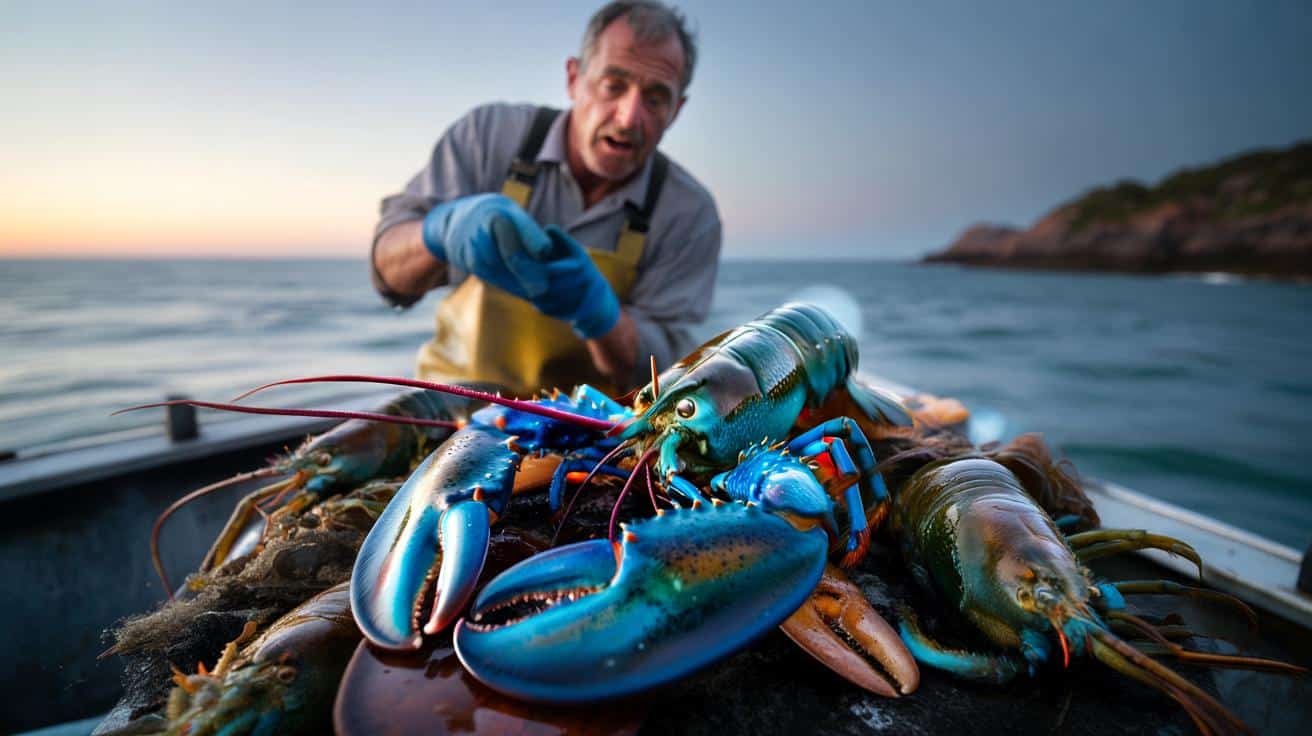
In the chilly Atlantic waters near Salem, a lobster boat crew recently pulled up something that looked more like a CGI prop than a living animal: a blazing electric-blue lobster, so rare that scientists estimate the odds of finding one at roughly one in 200 million.
An ordinary day on the water, until a flash of blue
It was July 2025, and lobster fisherman Brad Myslinski was working his usual grounds aboard his boat, the Sophia & Emma, off the coast of Salem, Massachusetts. The traps came up as they always do, heavy with shells, seaweed and the muted colours of the North Atlantic.
Then he saw it: a lobster so vividly blue it seemed to glow against the brown and green tangle of the catch.
Researchers estimate that only one American lobster in two million is blue, and the chance of actually hauling one aboard is closer to one in 200 million.
Myslinski realised almost instantly that this was not just a quirky colour variation. This was the kind of specimen scientists talk about in lectures. Rather than selling it on, he reached for his phone.
From fishing boat to science centre celebrity
Knowing he had something special, Myslinski contacted a local high school science teacher, who quickly put him in touch with the Northeastern University Marine Science Center in Nahant, just up the coast from Boston.
The centre agreed to take in the lobster, and students were invited to choose a name. They settled on “Neptune” – a suitably grand title for an animal that looks like it has been painted with neon ink.
Neptune now lives in a rocky touch tank at the centre, sharing space with tautog fish, sculpins, small crabs and green sea urchins. Visitors can see the lobster’s intense blue shell up close, and staff use the animal to talk about genetics, marine biology and ocean conservation.
Aside from its striking colour, Neptune behaves like any other American lobster: hiding under rocks, snatching food with quick claws and showing a fondness for mussels.
What makes a lobster electric blue?
The American lobster (Homarus americanus) usually comes in shades of dark greenish-brown. That camouflage blends perfectly with rocky Atlantic seabeds and shadowy crevices. So how does a lobster end up glowing cobalt blue?
➡️ A mine with a potential value of €120 billion found in the United States
➡️ How preparing once prevents repeated stress
➡️ Why a splash of vinegar in the cooking water keeps sausages from bursting
➡️ Psychology says preferring solitude over constant social life is a subtle sign of these 8 traits
Scientists at the Marine Science Center say Neptune carries a rare genetic mutation. The lobster’s body overproduces a protein complex called crustacyanin. This complex binds with pigments in the shell and shifts how light is absorbed and reflected.
The role of crustacyanin
- Normal lobsters: crustacyanin levels sit in a range that produces the typical brownish-green colour.
- Blue lobsters: excess crustacyanin distorts the pigment balance, turning the shell bright blue.
- After cooking: heat breaks down crustacyanin, revealing red-orange pigments underneath – which is why even blue lobsters turn red in boiling water.
This protein isn’t unique to lobsters. Related crustaceans like shrimp and crayfish carry it too, though the exact mix of pigments and proteins differs by species, leading to an impressive palette of natural shell colours.
Not just blue: a whole palette of rare lobsters
Neptune might be a statistical long shot, but American lobsters are already known for throwing out some rare and unusual colour morphs. These are typically tied to genetic quirks that affect how pigments are produced or organised in the shell.
Marine biologists and lobster researchers have recorded a surprising catalogue of lobster “variants”:
- Calico lobsters: speckled shells with patches of orange, brown and black.
- Yellow lobsters: bright yellow or golden bodies, sometimes with pale claws.
- “Cotton candy” lobsters: pastel shades of pink and baby blue, with an almost iridescent look.
- Albino or “crystal” lobsters: extremely pale animals lacking pigment, making them appear nearly white.
Each of these variations is rare in its own right, with estimates ranging from one in a few million to one in tens of millions, depending on the colour type. A pure albino lobster is considered one of the rarest of all.
Lobsters that can outlive humans
Beyond colour, lobsters fascinate scientists for another reason: their potential lifespan. American lobsters in the wild can live several decades, and some individuals are thought to reach close to 100 years old under the right conditions.
Part of the interest centres on an enzyme called telomerase. In many animals, telomerase activity drops as they age, which contributes to gradual cellular damage. Lobsters, by contrast, continue to produce telomerase throughout their lives, which helps maintain the ends of their chromosomes, called telomeres.
Continuous telomerase production is one reason researchers believe lobsters show slow, unusual patterns of ageing compared with many other animals.
This doesn’t make them immortal. They still face predators, disease, fishing pressure and the physical strain of moulting. But their biology offers clues to how ageing might be managed at a cellular level – a topic that attracts both marine biologists and medical researchers.
Why fishermen rarely keep rare-colour lobsters for the pot
When a blue or otherwise unusual lobster appears in a trap, many fishermen make the same choice Myslinski did: they call a local aquarium or science centre. The reasons go beyond sentiment.
| Option | Short-term gain | Long-term value |
|---|---|---|
| Sell for food | Standard market price per kilo | Animal disappears from public view and research |
| Donate to a centre | No direct profit | Education, tourism interest, potential scientific study |
| Release back to sea | No profit, no publicity | Preserves genetic variation in wild population |
For fishers working in tight-knit coastal communities, sending a rare lobster to a local institution can build goodwill, media attention and pride in the region’s marine life. Neptune has already become a talking point in Massachusetts, with school groups and families travelling to see the electric-blue celebrity.
What the odds really mean
The “one in 200 million” figure often circulates online as a quick headline, but the way researchers express rarity is a little more nuanced.
First, scientists estimate that roughly one in two million American lobsters carries a mutation that makes it blue. That’s the genetic piece. Then comes the question of probability in the real world: not all lobsters are caught, and not all caught lobsters are noticed, reported or saved.
When statisticians and marine biologists factor in how many lobsters are actually landed each year, how many end up in sorting bins unnoticed and how many survive long enough to be seen by humans, the practical odds of a fisherman landing and recognising such an animal shrink dramatically. That’s where numbers like “one in 200 million” come from.
What visiting Neptune can teach children (and adults)
At the Marine Science Center, staff use Neptune as a starting point to talk about broader topics that often feel abstract in a classroom. A single blue lobster can open up conversations about genes, mutation, natural selection, and the impact of fishing and warming oceans on marine life.
During school visits, educators might ask pupils to imagine alternative scenarios:
- Would Neptune have survived as long in the wild, given that bright blue is worse camouflage than muddy brown?
- Could such a visible animal be more vulnerable to predators, or would its rarity make little difference in the maze of rocks and kelp?
- How might climate change or pollution affect animals carrying unusual genetic traits?
These questions help turn a striking photo opportunity into a broader lesson on how small genetic changes can shape an animal’s fate.
From viral photo to real-world curiosity
Stories like Neptune’s often go viral on social media, reduced to a single snapshot and a staggering statistic about rarity. For coastal communities, though, they are reminders that the seafloor still holds surprises that science has not fully mapped.
For anyone planning a visit to an aquarium or marine centre, asking whether they house any rare colour morphs can lead to some unexpectedly rich conversations with staff. Behind the tanks and glass, there are often ongoing research projects on genetics, ageing, and how changing oceans might affect creatures from familiar lobsters to deep-sea oddities.
Neptune, hunted once by chance in the traps off Salem, now attracts a different kind of attention: thousands of eyes pressed to the edge of a tank, watching an electric-blue lobster do what lobsters have done for millions of years – search for food, hide among rocks and quietly outlive most of the people staring back.