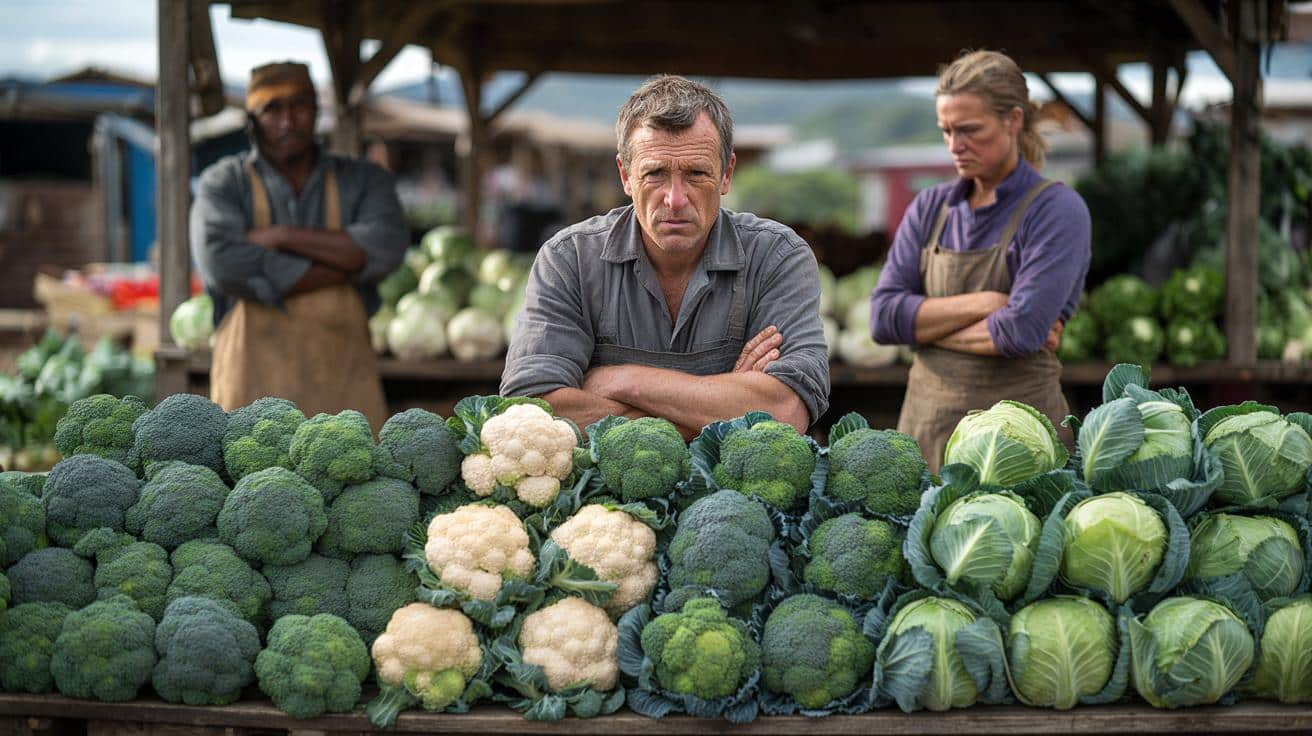
At the Saturday market, the vegetable stall looked like a still life painting: pyramids of broccoli, tight white cauliflowers, shiny green cabbages stacked like helmets. A little girl tugged on her mother’s sleeve and asked, “What’s the difference between this one and that one?” The mother didn’t even hesitate. “This is broccoli, that’s cauliflower, and cabbage is for soup. Totally different.” The farmer behind the table didn’t correct her. He just adjusted the prices and weighed another bag.
A few meters away, another grower sighed when I mentioned the scene. “They’re all the same plant, you know,” he muttered, tapping a crate of broccoli. “Centuries of work, and people still think they’re three different worlds.”
The stall was buzzing, kids grabbing florets, adults comparing recipes, everyone sure of what they were buying.
The long-kept secret was sitting right there in plain sight.
Wait… cauliflower, broccoli and cabbage are basically clones?
Botanically speaking, cauliflower, broccoli, cabbage, kale, Brussels sprouts and even kohlrabi are all the same species: Brassica oleracea. One single plant, many disguises. What changes is which part humans have selected and exaggerated over centuries: flowers for broccoli, flower buds for cauliflower, leaves for cabbage, mini-buds for Brussels sprouts.
This isn’t a geeky trivia detail. It completely flips the way we look at our plates, and at the work happening on farms. While we argue online about which veg is “healthier”, growers are dealing with a plant that behaves, reacts and suffers in almost the same way, no matter which “version” you buy.
And that gap between what we think we know and how farming really works is starting to irritate a lot of people in the fields.
Take Brittany in France, or Lincolnshire in the UK, or California’s Central Coast. Whole landscapes are patched in shades of green and white. From the road, one field looks like broccoli, the next like cauliflower, the next like tight green cannonballs of cabbage. Different crops, different risks, right?
Ask the farmers and they roll their eyes. Same species, same weather panic, same pests chewing the same leaves. If a hot spell hits during the wrong week, the “curds” of the cauliflower discolor, the broccoli buttons open too fast, the cabbages crack. Supermarkets reject an entire lot. Social media still buzzes about “broccoli shortages” as if it were separate from what happened to cauliflower across the road.
Out here, those marketing labels feel a bit like costumes on a single, slightly diva-ish plant.
➡️ A mine with a potential value of €120 billion found in the United States
➡️ French foreign trade booms in this Chinese region with +32.7% exports year‑on‑year to €432 million
➡️ Why a splash of vinegar in the cooking water keeps sausages from bursting
➡️ Psychology says preferring solitude over constant social life is a subtle sign of these 8 traits
Here’s the plain truth: the supermarket aisle teaches us more branding than biology. We’ve learned to see different shapes and colors as totally different foods, with totally different origins and stories. For farmers, that misunderstanding has a cost.
When customers think these are unrelated vegetables, they don’t get why prices move together, why one storm takes out “everything green”, why subsidies or insurance schemes don’t distinguish much between them. Behind the scenes, breeders cross the same species again and again, trying to get a cauliflower that can handle heat, a broccoli that lasts on the shelf, a cabbage that doesn’t crack in rain.
From a science point of view, it’s completely logical. From a consumer point of view, it feels like a plot twist nobody warned us about.
Why farmers are quietly fuming about your ‘broccoli vs cauliflower’ debates
Talk to growers and a pattern comes up fast. People lecture them about “diversifying crops” while pointing at broccoli, cauliflower and cabbage as if they were three different insurance policies. One farmer in Spain told me he’d been advised, with a straight face, to “switch from broccoli to more cauliflower for biodiversity”. Same species. Same pest pressure. Same climate risk. Different invoice line.
That mismatch filters into policy too. Aid programs, supermarket contracts, even sustainability labels often tick boxes based on crop names, not on the actual genetics behind them. On paper, a rotation of cabbage, broccoli and cauliflower looks rich and varied. In reality, it’s one species wearing three hats, exhausting the same soil traits year after year.
You’ve probably seen those glossy social posts: “Eat broccoli for detox, cauliflower for low carb, cabbage for gut health.” They rack up millions of views, and farmers see them too—sometimes on their phones, sitting in the tractor. One grower in Italy told me he watched a viral video trashing cabbage as “cheap and boring” while his cabbage field was bailing out a disastrous broccoli season.
Farmers aren’t angry that people love recipes or nutrition tips. They’re angry that the whole conversation floats above reality. When drought hits, all of these Brassica crops suffer together. When a new insect arrives, it doesn’t stop politely at the border of the broccoli plot. Yet customers ask, “Why is broccoli twice the price if cabbage is local and cheap?” and get offended when the answer starts with plant science instead of a discount.
From the growers’ side, there’s also a sense of invisibility. People celebrate “new superfoods” as if they pop out of an app, not a decade of field trials. Breeders have spent years tweaking the same genetic base to give you purple cauliflower, tenderstem broccoli, milder cabbages that don’t stink up the house.
And still, a lot of us treat vegetables like background noise: anonymous, replaceable, vaguely good for you. That’s where the frustration hardens. Farmers feel the weight of climate swings, price wars and fussy specifications, while customers pit one Brassica against another on Instagram.
One veteran grower from Normandy summed it up to me in a sentence that stuck.
How to shop, cook and talk about these “same plant” vegetables differently
If broccoli, cauliflower and cabbage are basically siblings, you can start treating them like a toolkit instead of rivals. Think textures and shapes, not rigid recipes. Want something that holds a bit of bite in a stir-fry? Broccoli florets or sliced cabbage stems will behave in almost the same way. Looking for a creamy mash? Cauliflower shines, but a finely shredded cabbage sautéed then blended with potatoes can surprise you too.
Next time you cook, try swapping one for another in a favorite dish. Use cabbage leaves instead of lasagna sheets, roasted cauliflower instead of potatoes, broccoli stems sliced thin in place of celery. Your body gets a similar nutritional family—fiber, vitamin C, sulfur compounds—while your tongue gets something new. That small mental shift moves you closer to the way farmers actually see their fields: a continuum, not a catalog.
There’s another area where this shared identity matters: your expectations. If heavy rain just wiped out local cauliflower, there’s a good chance broccoli and cabbage yields took a hit too. So when prices jump across all three, it’s not a conspiracy. It’s one stressed species signaling that the season went sideways.
We’ve all been there, that moment when you complain in the supermarket aisle because “even cabbage is getting expensive now”. From the grower’s point of view, that cabbage might be the last thing paying the bills after a brutal year. Showing a bit of flexibility—buying the “wrong” shape, accepting a few cosmetic flaws, shifting recipes—can ease pressure on farmers and reduce food waste.
Let’s be honest: nobody really pores over agricultural bulletins every single day. But just remembering that these vegetables are cousins helps your frustration land in the right place.
“People think we grow dozens of different vegetables,” a Portuguese farmer told me. “Most days, I feel like I work with one plant trying to survive climate roulette.”
That comment stuck with me on the drive home. It made me rethink how casually I used to talk about “variety” in my shopping basket. If one species is carrying so much of our winter eating habits, maybe our job as eaters is to show up a bit differently.
Here are a few quick shifts that come straight from growers’ wishes:
- Buy across the family: rotate between broccoli, cauliflower, cabbage, sprouts and kale instead of fixating on one.
- Say yes to ugly: take the yellowed cauliflower or slightly loose broccoli when you can, especially during tough seasons.
- Ask real questions: “How was the season for you?” opens more than “Why is this so expensive?”
- Cook the whole plant: stems, leaves and cores are edible and often delicious when sliced thin and sautéed.
- Talk about species: teaching kids that these are one plant in different forms plants a seed of curiosity.
So what do we do with this weird vegetable plot twist?
Once you’ve seen the trick, it’s hard to unsee it. That broccoli crown, that cauliflower “brain”, that humble cabbage—they’re like three actors playing different roles from the same script. Knowing this doesn’t kill the magic of cooking. If anything, it deepens it. You start to notice the small differences a season brings, the way a cold spring sharpens the taste, the way a dry summer toughens the stems.
It also raises uncomfortable questions. Why are we leaning so heavily on one plant in so many countries? What happens when rising temperatures push Brassica oleracea to its limits in coastal regions that have grown it for generations? Could our obsession with a few familiar shapes be blocking space on the shelves for genuinely different species that would spread risk for farmers?
You don’t need a degree in agronomy to do something with those questions. You just need to stay curious a bit longer the next time you stand in front of the vegetable case. Maybe you buy the cabbage grown 20 km away instead of imported broccoli. Maybe you ask your market stall what else from the same family they’re trialing this year. Maybe you cook one meal this week where the rule is: “Same species, totally different texture.”
*The story behind our food isn’t tidy or neatly labeled, and that’s exactly what makes it worth paying attention to.*
| Key point | Detail | Value for the reader |
|---|---|---|
| One species, many vegetables | Broccoli, cauliflower, cabbage, kale, sprouts and kohlrabi are all forms of Brassica oleracea | Changes how you understand your plate, nutrition trends and harvest shocks |
| Same risks in the field | Weather, pests and market swings often hit all these crops together | Helps you decode price changes and be more empathetic toward farmers |
| New ways to cook and shop | Think in textures and shapes, swap between Brassicas, accept cosmetic flaws | More creative meals, less food waste, closer link to real farming conditions |
FAQ:
- Question 1Are broccoli, cauliflower and cabbage really the same plant?
- Question 2Do they have the same nutritional profile if they’re one species?
- Question 3Why do farmers care whether we know this or not?
- Question 4Can I freely swap them in recipes without ruining the dish?
- Question 5What’s one simple thing I can do this week to support the growers behind these crops?